Editor’s note (23 April 2026). This article is educational only. The peer-reviewed evidence on technical analysis for individual investors is mixed at best; most academic studies find that the after-cost returns from active chart-based trading underperform a simple buy-and-hold index strategy. If you’re reading this to decide whether to start day trading, also read SEC Day Trading Investor Bulletin before committing capital. Full sources at the bottom.
Staring at a stock chart for the first time can feel like trying to decode ancient hieroglyphics. Those colorful lines, mysterious candlesticks, and confusing indicators might seem overwhelming, but here’s the truth: reading stock charts is a learnable skill that can dramatically improve your investment decisions.
Whether you’re planning your first stock purchase or looking to refine your trading strategy, understanding chart basics gives you a significant edge in the market. Think of stock charts as the financial equivalent of a medical X-ray – they reveal what’s happening beneath the surface that basic news headlines simply can’t capture.
Understanding the Foundation: What Stock Charts Actually Show
Stock charts are visual representations of a security’s price movement over time. Every chart tells a story about investor sentiment, market psychology, and the ongoing battle between buyers and sellers.
💰 Get Smart Money Tips Weekly
Join 1,000+ readers getting actionable personal finance advice every Sunday. Free, no spam.
The most fundamental element is price action – how a stock’s value changes from one moment to the next. When Apple trades at $185 per share at 10 AM and $187 at 2 PM, that $2 increase represents real money changing hands and real investor decisions being made.
The Anatomy of Price Movement
Price movements occur because of supply and demand imbalances. When more investors want to buy Tesla stock than sell it, the price rises. When selling pressure exceeds buying interest, prices fall. Charts capture this dynamic in real-time, showing you not just where a stock has been, but often hinting at where it might go next.
Volume – the number of shares traded – adds crucial context to price movements. A stock that jumps 5% on 100,000 shares carries different implications than the same move on 2 million shares. Higher volume typically confirms the strength of a price movement, while low volume might suggest the move lacks conviction.
Chart Types: Choosing Your Visual Language
Line Charts: The Simple Starting Point
Line charts connect closing prices with a single line, creating the smoothest visual representation of price movement. If Microsoft closed at $420 on Monday, $422 on Tuesday, and $419 on Wednesday, the line chart would connect these three points.
Line charts excel at showing long-term trends and are perfect for beginners who want to understand overall direction without getting distracted by intraday noise. They’re particularly useful for analyzing mutual funds or ETFs where minute-by-minute fluctuations matter less than monthly or yearly performance.
Candlestick Charts: The Professional’s Choice
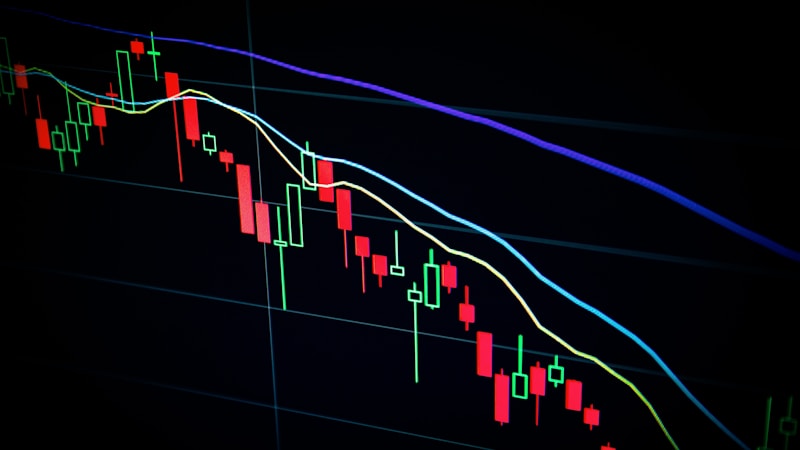
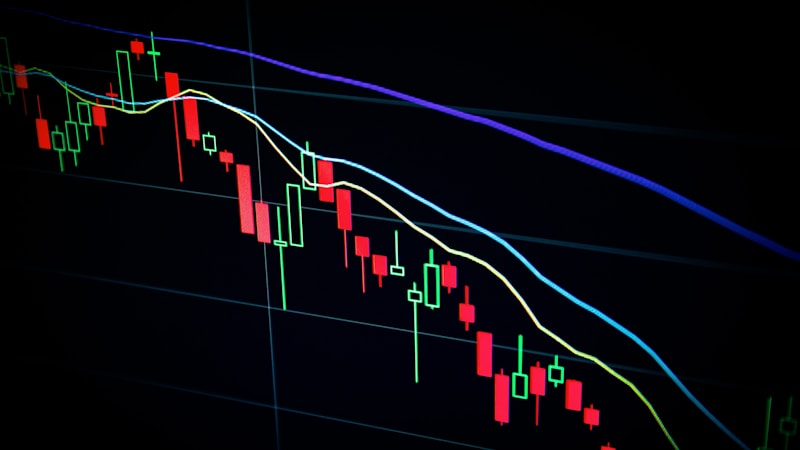
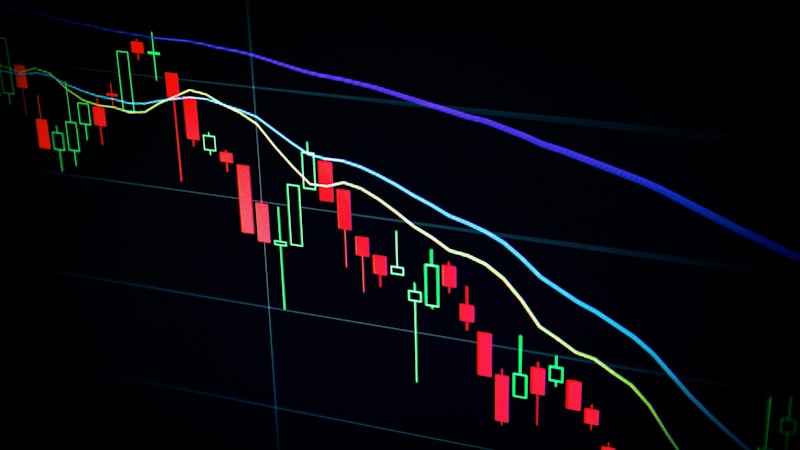
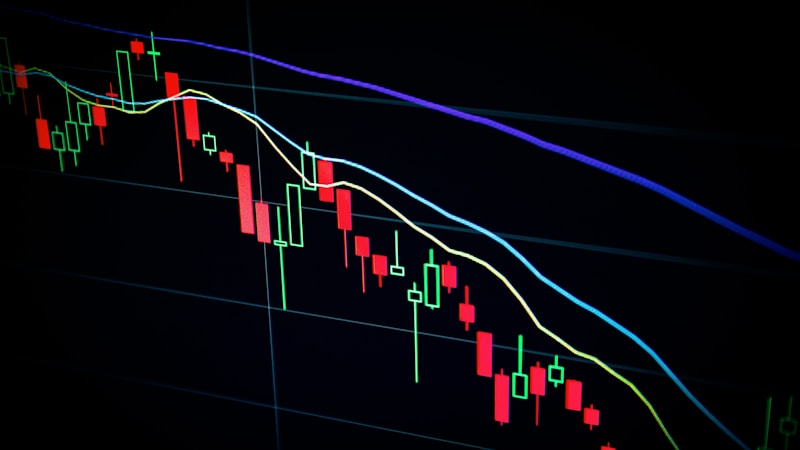
Candlestick charts pack significantly more information into each data point. Each “candle” shows four critical prices for a specific time period:
- Open: The first trading price
- High: The highest price reached
- Low: The lowest price touched
- Close: The final trading price
A green (or white) candle indicates the closing price exceeded the opening price – a bullish signal. Red (or black) candles show the opposite – bearish price action where sellers dominated.
Consider Amazon stock on a hypothetical trading day: Opens at $145, reaches a high of $148, drops to a low of $143, and closes at $147. The candlestick would show a green body from $145 to $147, with thin lines (called wicks) extending to $148 above and $143 below.
Bar Charts: The Middle Ground
Bar charts display the same four price points as candlesticks but use vertical lines instead of colored bodies. While less visually intuitive than candlesticks, some traders prefer bar charts for their clean, uncluttered appearance.
Time Frames: Matching Charts to Your Strategy
Intraday Charts (1-minute to 4-hour)
Day traders live in these time frames, making multiple trades based on short-term price swings. A 5-minute chart of Nvidia might show 15-20 price bars during a typical trading hour, each representing five minutes of market action.
These charts are excellent for timing entry and exit points but can be misleading for long-term investors. A stock might look terrible on a 15-minute chart while maintaining a perfectly healthy uptrend on the weekly chart.
Daily Charts: The Sweet Spot for Most Investors
Daily charts strike an ideal balance between detail and perspective. Each bar or candlestick represents one full trading day, making patterns more reliable than intraday charts while still providing enough detail for tactical decisions.
Most successful swing traders and position traders base their primary analysis on daily charts, using weekly charts for broader context and hourly charts for precise timing.
Weekly and Monthly Charts: The Big Picture View
Warren Buffett famously said his favorite holding period is forever – and weekly or monthly charts align with this long-term perspective. These time frames smooth out short-term volatility and reveal the major trends that create wealth over time.
A monthly chart of the S&P 500 shows the 2008 financial crisis as just one dramatic dip in an otherwise impressive decades-long uptrend. This perspective can prevent emotional decisions during temporary market turbulence.
Essential Chart Patterns Every Investor Should Know
Support and Resistance: The Market’s Memory
Support represents a price level where buying interest historically emerges. If Ford stock has bounced off $12 three times in the past six months, $12 becomes a support level that traders watch closely.
Resistance works in reverse – a price ceiling where selling pressure typically appears. Perhaps General Electric has struggled to break above $110 five times this year, making $110 a key resistance level.
These levels aren’t magical, but they reflect human psychology. Investors remember prices where they previously bought or sold, creating self-fulfilling prophecies as similar price levels trigger similar behaviors.
Trend Lines: Following the Flow
Uptrend lines connect successive higher lows, while downtrend lines connect successive lower highs. A properly drawn trend line on Coca-Cola’s chart might connect three low points over six months, each higher than the previous one.
The strength of a trend line increases with each successful test. A trend line touched only twice carries less weight than one that has guided price action for months while being tested multiple times.
Moving Averages: Smoothing the Noise
Moving averages calculate the average closing price over a specific number of periods, creating a smooth line that filters out day-to-day volatility. The 50-day moving average of Disney stock, for example, would average the closing prices over the past 50 trading days.
Common moving averages include:
- 20-day: Short-term trend identification
- 50-day: Medium-term trend analysis
- 200-day: Long-term trend confirmation
When a stock trades above its 200-day moving average, it’s generally considered to be in a long-term uptrend. Conversely, trading below this level often signals longer-term weakness.
Volume: The Truth Serum of Stock Charts
Volume validates price movements. When Netflix jumps 8% on earnings day with volume three times the daily average, the move carries more significance than the same percentage gain on quiet volume.
Volume Patterns to Watch
Breakout Volume: When a stock breaks above resistance, increasing volume confirms the breakout’s legitimacy. Low-volume breakouts often fail, while high-volume breakouts tend to continue.
Selling Climax: Extremely high volume during a sharp price decline often marks temporary bottoms. This pattern suggests panic selling has exhausted itself, potentially setting up a bounce.
Volume Divergence: When prices make new highs but volume decreases, it may signal weakening momentum. Smart money might be quietly selling while retail investors continue buying.
Practical Steps to Start Reading Charts Today
1. Choose Your Platform
Popular charting platforms include:
- TradingView: Comprehensive, user-friendly interface
- Yahoo Finance: Free, basic charting tools
- Broker platforms: E*TRADE, Fidelity, and Charles Schwab offer robust charting
- StockCharts.com: Professional-grade technical analysis tools
2. Start With Daily Charts
Begin your analysis with daily time frames. They provide enough detail for most investment decisions while filtering out meaningless short-term noise.
3. Identify the Primary Trend
Look at the overall direction over the past 3-6 months. Is the stock making higher highs and higher lows (uptrend), lower highs and lower lows (downtrend), or moving sideways (consolidation)?
4. Mark Key Support and Resistance Levels
Identify at least two significant support levels below the current price and two resistance levels above. These become your reference points for future price action.
5. Add a 50-day Moving Average
This single indicator helps identify medium-term trend direction. Stocks trading above their 50-day moving average are generally in healthier technical condition than those below.
Common Chart Reading Mistakes to Avoid
Over-analyzing Short-term Movements
New chart readers often obsess over every small price wiggle. Remember that daily fluctuations frequently mean nothing in the context of longer-term trends. Amazon dropping 2% on a Tuesday doesn’t negate a six-month uptrend.
Ignoring Volume Confirmation
Price movements without volume support often reverse quickly. Always check whether significant volume accompanies important price moves.
Drawing Perfect Lines on Imperfect Data
Support and resistance levels aren’t laser-precise. A stock might find support anywhere between $48.50 and $49.50, not exactly at $49.00. Allow for reasonable wiggle room in your analysis.
Confusing Correlation with Causation
Charts show what happened, not why it happened. A stock might decline after touching its 200-day moving average, but the moving average didn’t cause the decline – it simply marked a level where sellers became more aggressive.
Building Your Chart Reading Routine
Weekly Chart Review Process
Set aside 30 minutes every Sunday to review your holdings:
- Check the weekly chart for each position to confirm the long-term trend remains intact
- Review daily charts to identify any new support or resistance levels
- Note volume patterns during the previous week’s trading
- Update your watchlist with stocks showing interesting technical setups
Daily Quick Checks
Spend 5-10 minutes each morning reviewing:
- Overnight news that might affect your positions
- Pre-market price action on your holdings
- Key technical levels that might come into play during the session
Advanced Concepts for Continued Learning
Japanese Candlestick Patterns
Named patterns like “hammer,” “doji,” and “engulfing” provide additional insight into market sentiment. A hammer formation at a key support level, for example, often signals a potential reversal.
Technical Indicators
While moving averages provide a solid foundation, indicators like RSI (Relative Strength Index), MACD (Moving Average Convergence Divergence), and Bollinger Bands add layers of analysis for those ready to dig deeper.
Multiple Time Frame Analysis
Professional traders analyze the same stock across different time frames – perhaps weekly charts for trend direction, daily charts for setup identification, and hourly charts for entry timing.
Frequently Asked Questions
How long does it take to become proficient at reading stock charts?
Most investors can grasp basic chart reading concepts within 2-3 weeks of consistent study and practice. However, developing true expertise takes months or years of real-world application. Start with simple concepts like trend identification and support/resistance levels before moving to advanced patterns or indicators.
Can chart reading alone predict stock prices?
No single analysis method can consistently predict future prices. Charts excel at showing probability and context, not certainty. Successful investors typically combine technical analysis with fundamental research, considering factors like company earnings, industry trends, and economic conditions alongside chart patterns.
What’s the most important thing for beginners to focus on?
Master trend identification first. Before worrying about complex indicators or exotic patterns, learn to reliably determine whether a stock is trending up, down, or sideways over different time frames. This single skill will improve your investment results more than memorizing dozens of candlestick patterns or technical indicators.
Chart reading transforms from an intimidating puzzle into a valuable skill through consistent practice and patience. Start with the basics outlined here, paper trade your ideas before risking real money, and gradually build complexity as your confidence grows. Remember, even the most sophisticated traders rely on these fundamental concepts – they just apply them with years of hard-earned experience.
Sources
- SEC — Day Trading Tips for Investors — regulator’s investor bulletin on the risks of day trading, required reading before committing real money.
- FINRA — Day-Trading Margin Requirements — the Pattern Day Trader rule and the $25,000 minimum equity requirement under FINRA Rule 4210.
- CFA Institute — Technical Analysis — survey of the academic literature on technical analysis and its practical utility.
- Barber & Odean (2000) — “Trading Is Hazardous to Your Wealth” — foundational academic paper showing active retail traders systematically underperform buy-and-hold.
- Fama & French — Three-Factor Model — the most-cited paper on asset-pricing, implicitly relevant when thinking about what chart patterns can and cannot explain.
- Investopedia — Candlestick patterns — consumer-facing reference for identifying candle patterns.
- TradingView Chart School — free interactive lessons on reading charts.
Chart reading is a useful skill for understanding market behaviour, but don’t confuse pattern recognition with predictive power. The academic consensus is that consistent profits from technical analysis alone — net of trading costs — are rare. This article is general information, not a recommendation to day trade or time the market.
Fact-checked by Sergio Ligero on 23 April 2026 against the sources listed above.